AustCham NextGen 2025 · Speaking + Sustainability
Sustainability Reimagined — AustCham NextGen 2025
What traditional architecture can teach us about building performance, simulation, BIM, and AI.
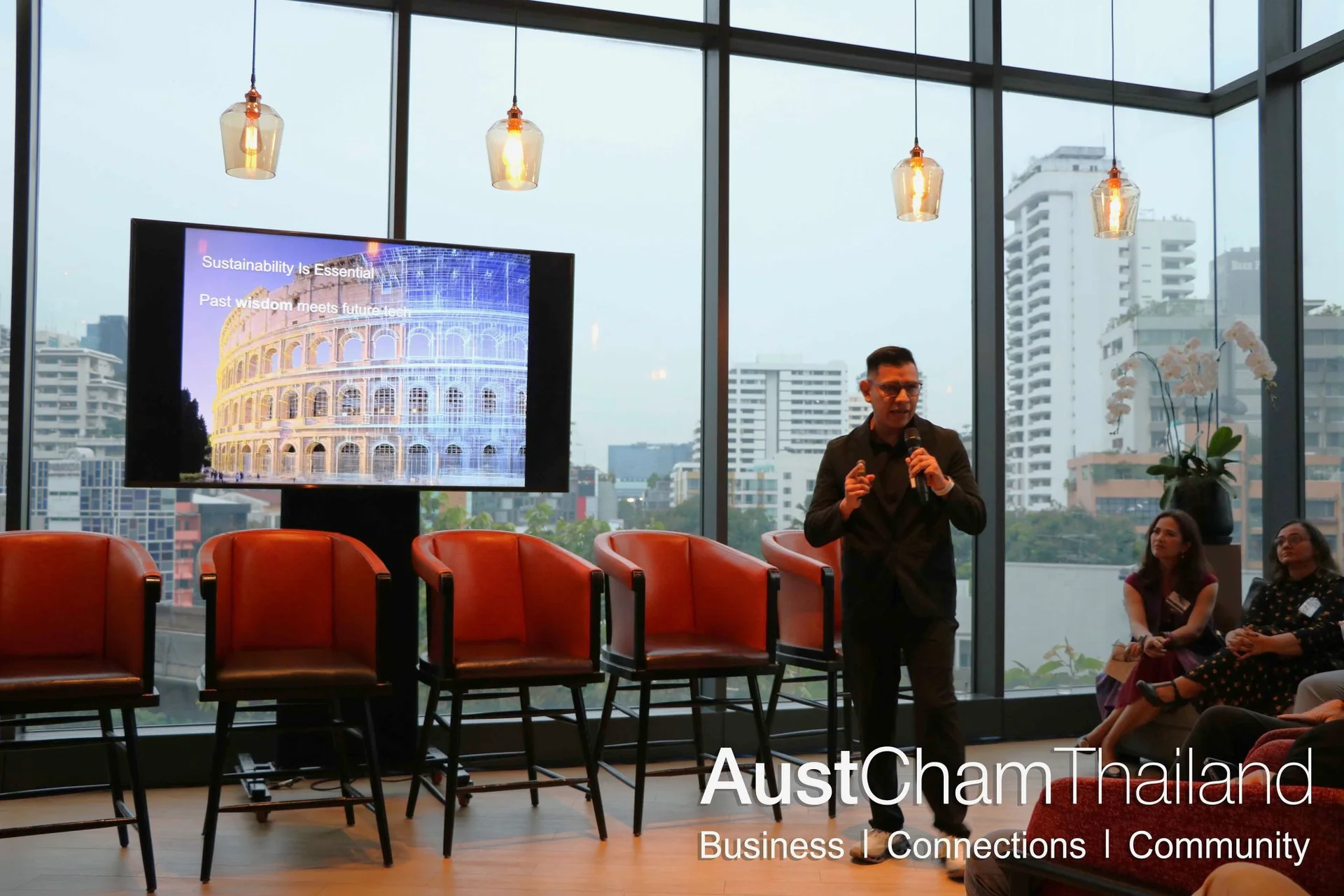
- Event
- AustCham Thailand NextGen’s TEDx-Inspired Talks 6
- Date
- Location
- Hyatt Regency Bangkok Sukhumvit, Bangkok, Thailand
- Session
- Sustainability Reimagined: The Why, Who, What & How
- Role
- Speaker and panel participant · BIM & Sustainability Manager, dwp
- Topics
- sustainability · bim · computational design · ai
By Danny Bentley · Published
On 21 May 2025, I spoke and joined the panel at AustCham Thailand NextGen’s TEDx-Inspired Talks 6 at Hyatt Regency Bangkok Sukhumvit in Bangkok, Thailand. The theme was Sustainability Reimagined: The Why, Who, What & How. Listed as BIM & Sustainability Manager at dwp, I approached the topic through architecture: what we can learn from the past, test in the present, and ask of future tools.
What happens when the power goes out?
I began with a question: what happens when the power goes out across Bangkok?
Without air conditioning, electric lighting, elevators, and constant mechanical systems, how many of our buildings would remain livable? The question asks us to look beyond normal operating conditions. It brings building performance back to the experience of people inside: whether there is enough light, whether air can move, and whether spaces remain comfortable and accessible.
Modern systems are essential to many buildings. But dependence on them also makes it worth asking what the architecture itself contributes.
Sustainability before technology
Traditional Thai architecture offered a starting point. Raised floors, deep eaves, and natural ventilation responded to climate through the arrangement of space and the building envelope. Airflow and passive cooling were part of how a building worked, rather than something added after its form was settled.
Local materials, vegetation, and the management of water also belonged to that conversation. Raised spaces and responses to flooding connected everyday use with resilience. These decisions made sense in relation to particular places, resources, and ways of living.
That does not make every traditional building sustainable, or mean that passive design can replace every modern system. My point was that climate-responsive thinking has a long history. We can carry that knowledge forward while questioning which principles fit a contemporary project.
Simulate before you build
Today, we can test more of those decisions before construction. Solar and shadow analysis help us understand exposure. Daylight and comfort studies make it possible to question orientation, openings, and shading while a design is still flexible.
Site-layout and building-form optimization extend that process. Instead of treating a first arrangement as fixed, teams can compare alternatives and understand the consequences of changing massing, orientation, or materials.
BIM collaboration helps connect these studies with the design that different disciplines are developing. The value is in making better decisions early, while changes remain relatively easy. An analysis matters when its findings influence an architectural choice. This is also the practical connection behind my work in AI + Sustainability.
AI and the future
The future section considered AI-assisted design, generative approaches, material reduction, performance optimization, and future materials. These tools open possibilities for exploring options and bringing more data into design decisions.
They still need a useful question and a meaningful basis for comparison. Producing more alternatives does not establish which one suits a site, its occupants, or the resources available. An apparent improvement in one measure also needs to be considered alongside the rest of the building.
Technology needs wisdom, context, and human insight. AI does not automatically produce a sustainable building. Its contribution depends on how we frame the problem, judge the results, and act on what we learn.

Sustainability is timeless
The thread through past, present, and future was intelligent design: learning from climate-responsive architecture, testing decisions with modern analysis, and using future tools with judgment.
Technology changes. The fundamental goal remains to design buildings that respond intelligently to climate, people, and place.
The principle