Case Study
Janet Echelman — Computational Sculpture Framing & Net Systems
Python-driven parametric modeling of structural framing and tensioned net geometry for large-scale sculptural collaboration at SOM.
- Role
- Parametric Design Technologist
- Status
- Built Work
- Stack
- Python, Computational Geometry, Parametric Modeling, Structural Systems
TL;DR: Computational collaboration with Janet Echelman and SOM to model structural framing and tensioned net geometry using Python-driven parametric tools. Built a voice AI pipeline connecting Amazon Alexa to the Revit API to drive real-time net geometry calculations.
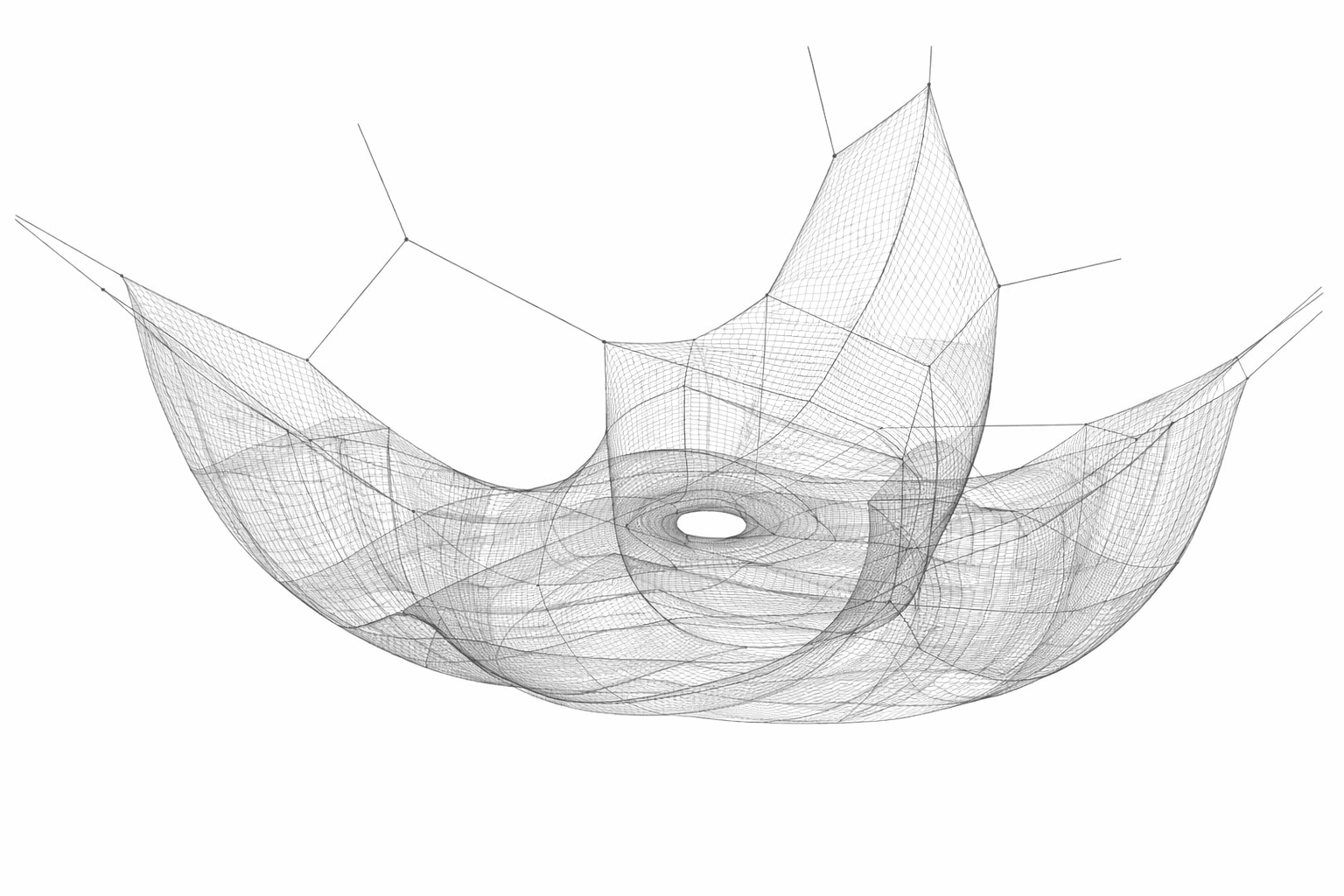
Computational collaboration with Janet Echelman and SOM focused on the development of structural framing and tensioned net systems using Python-driven parametric modeling.
Voice-Driven Revit Modeling
This video demonstrates an early experiment using a voice AI skill built with Amazon Alexa to drive a Janet Echelman net sculpture model in Revit. The core challenge was connecting a cloud of structural anchor points with the correct netting geometry. A calculation that needed to happen fast enough to be useful during design.
The workflow used NGrok to bridge Amazon's Alexa service directly to the Revit API. When a voice command was issued, it triggered the point-to-point connection algorithm and recalculated the netting size in real time.
Janet Echelman's large-scale net sculptures demand engineering precision: the span between anchors, the load distribution across the net, and the fabricated mesh size all have to reconcile. At SOM we used code to solve that speed problem.
My Role
- Developed scripted geometry systems for framing logic
- Built the voice AI to NGrok to Revit API connection pipeline
- Implemented point-to-point connection algorithm for net geometry
- Modeled layered net structures with parametric control
- Supported structural rationalization through computational workflows
Dream Catcher — Interactive Weave Explorer
The tool below lets you grow a parametric dream-catcher structure from scratch. Hit Generate Points to seed a field of nodes inside the boundary ring, then Connect Threads to weave them into a tensioned network. The Radius slider is the key control. Small values produce a tight local weave. Large values span the full circle with open, bridging threads. After the threads draw in, a spring relaxation settles the web into its final tensioned form.
generate points · connect threads · adjust radius to explore the weave
Key Takeaways
- Parametric modeling tools reduce the manual calculation overhead in large-scale structural geometry
- Connecting voice AI to the Revit API creates a real-time feedback loop between design intent and model output
- Code-driven workflows let designers explore structural options faster than manual iteration
- Net geometry (span, load, mesh size) requires precision at every scale of an Echelman installation
References
My Role
Parametric Design Technologist